
Project introduction & basic electricity
MODULE 1 - 2 hours

Learning objectives
To learn about the project and basic electricity
Go through Theory part and then 360-simulation
Module 1 — Project introduction & basic electricity
Work through the theory presentation above, then complete the 360° simulation. This module introduces the EcoCharge project and the basic electricity you need to build an electric bike.
About EcoCharge
EcoCharge turns ordinary bicycles into electric ones with a low-cost, recyclable kit, making clean mobility affordable. Following circular-economy principles, it reuses parts from old bikes and cars. It is designed for regions like Malawi and Zambia, where bicycles are a key means of transport and only about 11% of people have electricity, so the bike can also generate energy for lighting and charging.
Three ways to build an e-bike
1. Buy a kit (e.g. Bafang): battery, motor and controller included. Easy plug-and-play, but costs about €600-1000, is not recyclable, and is not compatible with every frame.
2. Recycled alternator + bought battery: a car alternator used as the motor plus a ready-made 48 V battery; you buy only the controller. Cheaper (about €400-700) and more instructive, but bulkier and less universal.
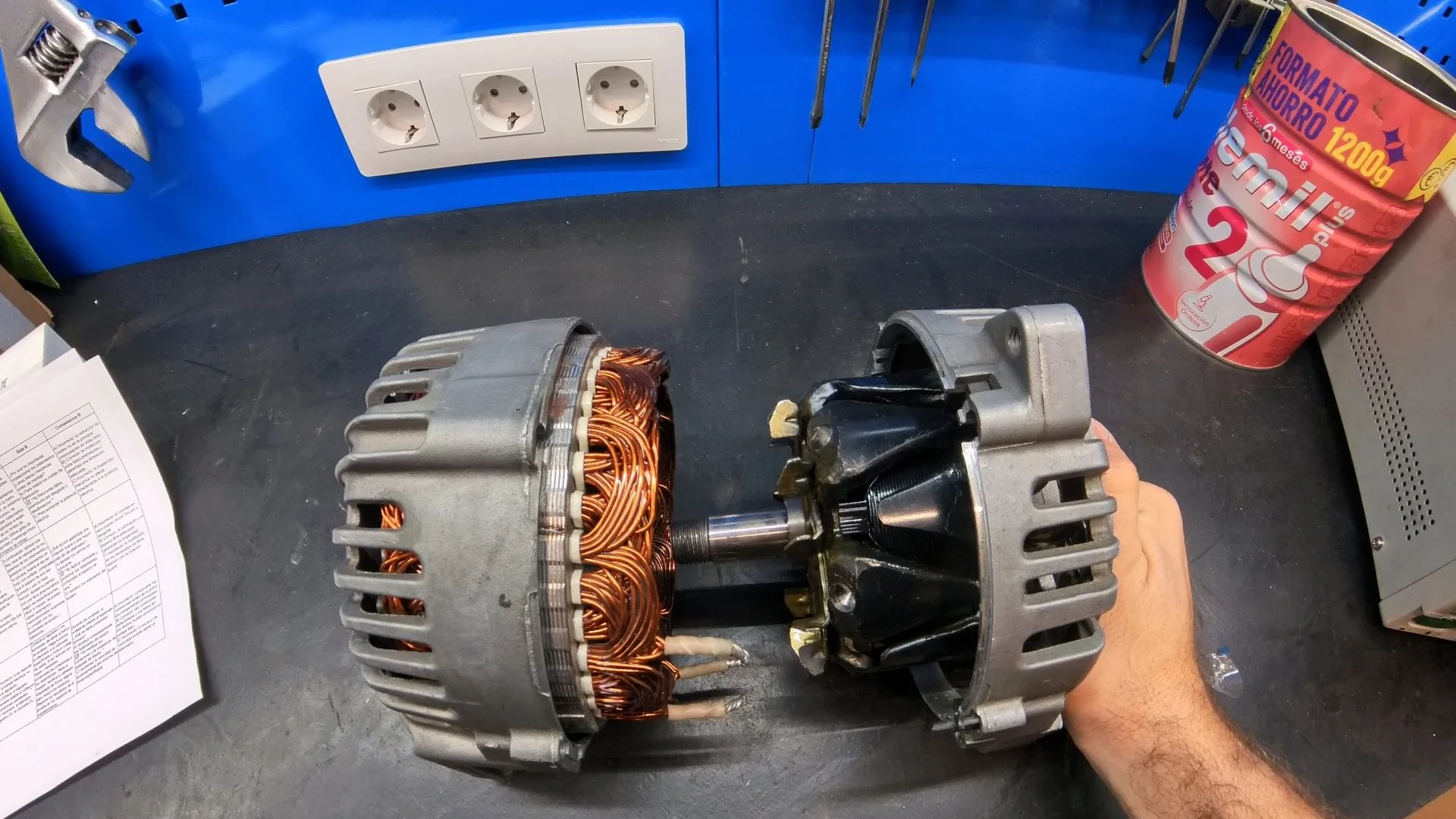
3. Recycled alternator + self-made battery (chosen for EcoCharge): recycle the alternator and build the battery from cells. Fully recyclable and the most instructive, though it needs a cell-welding machine. Controller parts cost only about €18.
Basic electricity you need
Ohm's Law: V = I × R (rearrange as I = V / R or R = V / I).
Electrical power: P = V × I, also P = I²R = V² / R. Measured in watts (W); 1 kW = 1000 W.
Resistors in series: Rt = R1 + R2 + R3 + ...
Resistors in parallel: 1 / Rt = 1/R1 + 1/R2 + 1/R3 + ...
Mixed circuits: simplify the parallel groups first, then add the series parts.
Practice exercises
1. Find the total resistance Rt. A) three resistors in series: 1/2 Ω, 6.3 Ω, 6/5 Ω. B) two resistors in parallel: 4 Ω and 28 Ω.
2. A 220 V source feeds 25 Ω and 55 Ω in series. Find the current I.
3. Find the total resistance Rt. A) 6 Ω in parallel with 18 Ω, in series with 3/2 Ω. B) 13 Ω and 12 Ω in series, in parallel with 40 Ω.
4. A 4 Ω and a 16 Ω resistor in parallel are in series with 23 Ω; the current is 5 A. Find the source voltage V.
5. 29 Ω and 7 Ω in series form a branch in parallel with 12 Ω, fed by 27 V. Find the current I.
6. 1/4 Ω and 1/6 Ω in series form a branch in parallel with 5/8 Ω, then in series with R, fed by 12 V with 1.5 A flowing. Find R.
7. With R1 = 4.7 Ω, R2 = 9.1 Ω, R3 = 4.7 Ω, R4 = 2.2 Ω, R5 = 10 Ω, R6 = 12 Ω and V = 10 V: the top branch is R1 in series with (R2 parallel R3) in series with R4; the bottom branch is R5 + R6; the two branches are in parallel. Find the equivalent resistance and the current I.
8. Calculate the power in the bulb, the motor and the total. A) motor (1 Ω) and bulb (3 Ω) in series at 9 V. B) bulb (6 Ω) and motor (4 Ω) in parallel at 7.2 V.
Answer key
1. A) 0.5 + 6.3 + 1.2 = 8 Ω. B) (4 × 28) / 32 = 3.5 Ω.
2. R = 25 + 55 = 80 Ω, so I = 220 / 80 = 2.75 A.
3. A) (6 × 18) / 24 = 4.5 Ω, + 1.5 = 6 Ω. B) 13 + 12 = 25 Ω, in parallel with 40 → 15.4 Ω.
4. 4 parallel 16 = 3.2 Ω, + 23 = 26.2 Ω, so V = 5 × 26.2 = 131 V.
5. 29 + 7 = 36 Ω, in parallel with 12 → 9 Ω, so I = 27 / 9 = 3 A.
6. 1/4 + 1/6 = 0.417 Ω, in parallel with 5/8 → 0.25 Ω. Total = 12 / 1.5 = 8 Ω, so R = 8 - 0.25 = 7.75 Ω.
7. R2 parallel R3 = 3.1 Ω, so the top branch is about 10 Ω; the bottom branch is 22 Ω; equivalent = (10 × 22) / 32 = 6.88 Ω, so I = 10 / 6.88 = 1.45 A.
8. A) I = 9 / 4 = 2.25 A, so bulb = 15.19 W, motor = 5.06 W, total = 20.25 W. B) bulb = 7.2² / 6 = 8.64 W, motor = 7.2² / 4 = 12.96 W, total = 21.6 W.